Thérèse Anger
Felix AustriaThérèse Anger is Doctor Anger’s dead wife and Adèle’s mother, remembered as a vivid, emotional woman whose life ended in the fire of September 28, 1868. She remains present not through direct action in the later story but through the doctor’s memories, the mourning that shaped his household, and Petro’s marble sculpture of her. The contrast between a life lost to catastrophe and an image made to endure gives her memory a quiet force in the novel’s treatment of grief, love, and permanence.
Identity and Background
Thérèse lived in Stanislaviv with Doctor Anger and longed to have children. The doctor recalled her as prone to tears in every circumstance: happiness, sorrow, or apparently no reason at all. A clouded sky could move her, as could news of a neighbor’s servant becoming pregnant or a guest’s compliment on a roast she had prepared. She ate peaches with a spoon and embroidered patterns that her husband considered foolish. These domestic details make her more than the idealized figure on her tomb: she appears as a particular person with habits, sensitivities, and a life shared with her husband.
Her wish for children shaped an intimate conflict with Doctor Anger. He argued that corsets harmed the body by compressing and displacing the internal organs, and might contribute to her infertility. Thérèse resisted discussing the matter because she considered it improper, but eventually agreed to wear only a light corset, and to have it fastened only halfway, at costume balls and receptions. The recollection records both the limits imposed by social propriety and the couple’s effort to negotiate them in the hope of having children.
Death and Its Aftermath
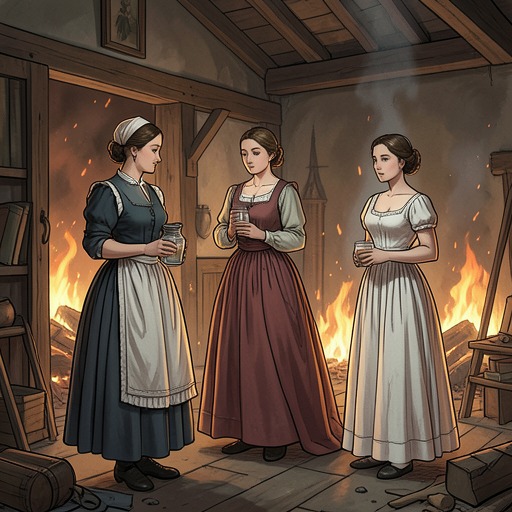
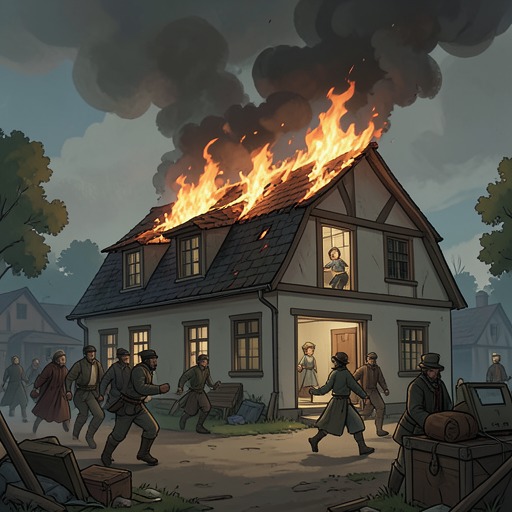
Thérèse died in the fire of September 28, 1868. A jam was being prepared in the Lothringer garden when the blaze took half the city; Thérèse was among those killed. Doctor Anger never recovered from her loss, and jam was never served at his table afterward. The absence of that ordinary food turned a household custom into a continuing trace of the disaster: the fire’s consequences persisted in what the family would not eat as well as in what it remembered.
The same fire killed Stefania’s parents, whose neighboring house vanished without a trace. Stefania and Adèle were rescued by neighbors and returned to Doctor Anger together, wrapped in soot-stained, smoke-smelling cloths. The two girls’ survival thus began in the same catastrophe that took Thérèse. For Stefania, the memory of her own mother is linked to the lilacs growing where the family home once stood, while Adèle grew up beside the lasting absence of hers.
Memory in Marble
Years later, Doctor Anger spoke about Thérèse while Petro worked on a block of marble. Watching the sculptor’s precise hammer blows, the doctor recalled her habits and their life together. He described returning from the hospital late at night, knocking softly at her bedroom door, entering with a candle after hearing her quiet permission, and approaching her bed among its soft quilts and pillows. As Petro shaped the marble face, the doctor approved of the likeness, recognizing in it the intimacy of that remembered scene.
The finished sculpture places Thérèse dreaming on a stone bed beneath the linden trees in the cemetery. Her head rests casually on her right shoulder; her slender arms lie across the creased bedding. A grieving angel beside her raises a hand to its brow and looks toward the sky. The angel’s acute sorrow contrasts with Thérèse’s peaceful expression: the sculpture shows no visible pain, making the grief around her more striking. Petro’s art arrests the viewer before cold stone, yet gives it a form so lifelike and composed that it seems to hold a silence capable of drawing out emotion.
Private Grief and Imperial Permanence
Thérèse’s fate complicates the novel’s image of a prosperous, multicultural Galicia remembered through the idea of Felix Austria. Public celebrations and imperial emblems promise continuity: the city marks Emperor Franz Joseph I’s seventieth birthday with flowers, banners, and ceremony, while the motto Felix Austria appears even in its poorest quarters. Yet the fire that killed Thérèse and destroyed homes demonstrates how fragile that apparent security is. Doctor Anger’s grief persists for decades, where official pageantry cannot repair private loss.
The novel brings that tension to a final, personal expression in Stefania’s declaration that her love is solid, infallible, and eternal, like the Austro-Hungarian Empire. The comparison gives private feeling the language of imperial permanence even as the burning house and its liquefying, disappearing possessions make permanence impossible to trust. Thérèse’s marble likeness stands between these ideas: it preserves a remembered face, but cannot restore the woman or undo the fire.